 Philoclopedia
Relativitätstheorie
Die Relativitätstheorie befasst sich mit der Struktur von Raum und Zeit, dem Verhalten von Masse in selbigen (SRT) und setzt das alles in Abhängigkeit zur Gravitation (ART).

Rückblick
Anfang des 20. Jahrhunderts fußte das naturwissenschaftliche Verständnis von Raum, Zeit und Gravitation noch auf der newtonschen Physik. Die newtonsche Physik malte uns ein Bild des Universums mit Raum und Zeit als absolute, d.h. unveränderliche und voneinander unabhängige Größen. Die Gravitation zeichnete er als Kraft zwischen zwei Massepunkten.
Überblick
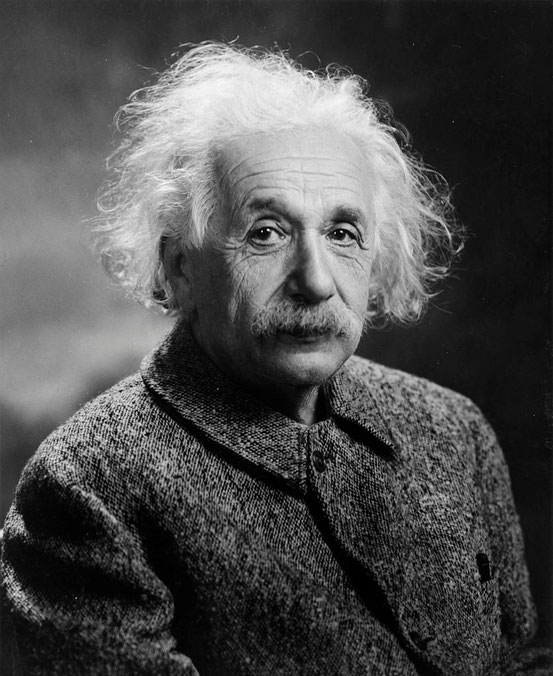
In den Jahren von 1905 bis 1916 erfuhren diese Auffassungen dann eine radikale Revolution, ausgelöst durch eben jene Relativitätstheorie. Der theoretische Physiker Albert Einstein war maßgeblich an ihr beteiligt.
Die nächsten Abschnitte werden versuchen, die Grundlagen der Relativitätstheorie zusammenzufassen. Dabei muss der Prägnanz wegen auf Erläuterungen und Details verzichtet werden. Sie finden jedoch unter jedem Abschnitt Hinweise zu weiterführende Aufsätze. Falls Sie sich also näher für eines der aufregenden Phänomene der RT interessieren, klicken Sie sich einfach weiter.
1. Spezielle Relativitätstheorie
Häufig wird behauptet, Einstein habe Newton widerlegt. Das ist falsch, er verbesserte ihn lediglich durch eine allgemeinere Theorie. Mit seiner speziellen Relativitätstheorie entlarvte Albert Einstein nämlich Raum, Zeit und Bewegung als relative Größen. Die newtonsche Physik war damit entthront und ist in Einsteins Theorie nur noch als ein besonderer Grenzfall enthalten.
Doch nicht nur das, die spezielle Relativitätstheorie kann uns auch zeigen, dass Raum und Zeit gar nicht unabhängig voneinander existieren. Vielmehr verschmelzen die beiden in der SRT zu einer einheitlichen Raumzeit.
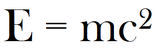
Auch die Masse M und die Energie E erwiesen sich in ihrer weltbekannten Gleichung (s.o.) als zwei Seiten derselben Medaille. Zusammengehalten werden diese schließlich noch durch die Lichtgeschwindigkeit C, die entgegen allen anderen relativen Bewegungen und Geschwindigkeiten immer konstant und unabhängig vom Bezugsystem ist.
2. Allgemeine Relativitätstheorie
Elf Jahre später entwarf Einstein seine Allgemeine Relativitätstheorie. Diese berücksichtigt auch die Fälle, in denen die Gravitation eine Rolle spielt. In zehn Feldgleichungen verwarf Einstein den newtonschen Gedanken, Gravitation sei eine Kraft, die sich ohne Zeitverlust ausbreite. Anstelle dessen fasst er die Gravitation als Eigenschaft der gekrümmten Raumzeit auf. Materie krümmt das Raumzeit-Kontinuum und so entsteht Schwerkraft.
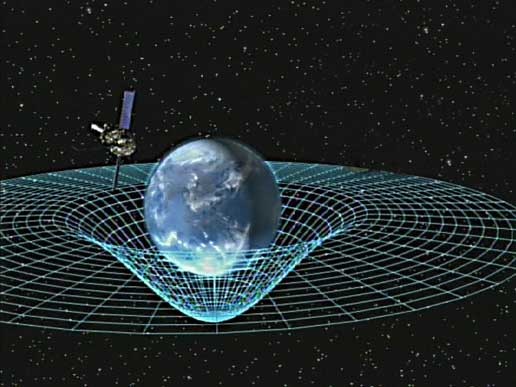
Das Schwerefeld kann man sich wie eine unsichtbare, gespannte Gummihaut vorstellen. Liegt nun ein massereicher Körper, etwa eine Sonne, in ihm, wird sie gekrümmt. Dementsprechend drückt sich auch die Gummihaut ein, wenn man einen Ball auf sie legt. Infolge der derart modifizierten Geometrie der Raumzeit ändert sich sogar der augenscheinlich so geradlinige Verlauf der Lichtstrahlen, die von den Massekörpern ausgehen. Erfasst vom Schwerefeld sucht sich der Lichtstrahl nun einen neuen, kürzstmöglichen Weg. Aus diesem Grund können wir auch noch die Sterne sehen, die sich eigentlich knapp hinter dem Sonnenrand verbergen.
3. Ausblick
Man kann sich wieder und wieder mit der Relativitätstheorie befassen und wird trotzdem niemals zu dem Gefühl kommen, alle ihre Konsequenzen durchgedacht zu haben. So geht es zumindest mir, immer wieder aufs Neue stehe ich vor Situationen, bei denen ich nicht weiß, wie man sie sich gemäß der RT denken soll. Oder die einem immer noch extrem komisch und unreal vorkommen.
Dabei lassen sich die Vorgänge und Eigenschaften innerhalb der Relativitätstheorie mathematisch unglaublich präzise beschreiben und gehören zu den bestbestätigten in der Geschichte der Naturwissenschaften. Dies klassifiziert sie, zusammen mit der Quantentheorie, als eine der besten Theorien der Gegenwart.
Zusammen mit der Quantentheorie stellt die Relativitätstheorie eine der zwei tragenden Säulen der modernen Physik dar. Beide gingen ursprünglich aus der newtonschen Physik hervor, enthalten diese immer noch als Spezialfall und erfüllen somit das Korrespondenzprinzip. Die Bemühungen vieler Physiker gelten dieser Tage der Vereinigung dieser beiden Säulen, wobei meist versucht wird die Relativitätstheorie in die Quantentheorie zu integrieren, und nicht andersrum.
In den Quantenfeldtheorien konnte man bereits die spezielle Relativitätstheorie mit der Quantentheorie und im Rahmen des heutigen Standardmodells der Physik einen. Der noch außenstehenden Quantentheorie, die auch noch die allgemeine Relativitätstheorie bzw. die Gravitation mit ins Boot nimmt, will man dann den Namen Quantengravitationstheorie geben.
4. Verweise
- Intelligenz: Albert Einstein war ein sehr intelligenter Mensch. Intelligenz aber ist kein reines Bücherwissen und nicht bloß das Resultat testorientiertem Spezialtrainings. Es ist vielmehr eine breite und tiefe Begabung zum Verständnis unbekannter Problemfelder.
- Raum und Zeit: Die Relativitätstheorie hat uns dem Wesen von Raum und Zeit erheblich näher gebracht. Sie kann aber nicht das letzte Wort gewesen sein, wie sich beispielsweise an Schwarze Löchern zeigen lässt.
- Sprache: Issac Newton meinte noch: “Die absolute, wahre und mathematische Zeit verfließt an sich und vermöge ihrer Natur gleichförmig, und ohne Beziehung auf irgendeinen äußeren Gegenstand.” Wir wissen es heute besser. Außerdem ist die Aussage „die absolute Zeit fließt gleichförmig“ tautologisch. Sie hat keinen Informationswert, da die absolute Zeit per definitonem immer gleichförmig fließt. Weil, wie könnte man den gleichmäßigen Fluss einer absoluten Zeit überprüfen, wen nicht mit der absoluten Zeit selbst und wie könnte uns ihr Fluss in diesem Fall anders erscheinen, als gleichmäßig? Ähnliches gelte für einen absoluten Raum, der beispielsweise nicht relativ ist. Was Raum und Zeit aber nach unserem heutigen Verständnis sei, geht vollkommen gegen das, was man intuitiv annehmen würde: Raum und Zeit sind keine Bühne, vor deren Hintergrund sich alles Materielle abspielt. Vielmehr sind Raum und Zeit intrinsische Eigenschaften der Materie, die ohne sie gar nicht existieren würde.
- Unser Problem: Was für die unanschauliche Quantenwelt gilt, gilt in abgeschwächter Form also auch für die Relativitätstheorie: Sie entspricht nicht unsere Alltagsmeinung und Intuition. Was sie aber nicht falsch macht. Wir erleben im Alltag nun mal so etwas wie die newtonsche Welt, sprich keine schnellen Bewegungen, keine kleine Skalen. Deshalb ist man auch lange Zeit so gut mit Newton gefahren. In weniger alltäglichen Situationen aber, wie etwa am Rande supermassiver schwarzer Löcher oder im Inneren eines Atoms, versagt Newtons Physik. Spätestens an dieser Stelle braucht es dann die Quantentheorie, und die Relativitätstheorie.
Stand: 2015
Hiroji kurihara (Samstag, 24 Dezember 2022 10:34)
Gravity and Time Dilation
There are two mirrors. One is on the ground, one is 22.6m above. These are facing each other. A laser beam is emitted downward from the left end of the upper mirror, forming letter W, and is coming to the upper right (beam is in vacuum). Frequency at five points will be the same. There will be no time dilation due to difference of gravity.
Note) A few translated books say that (outline), when the distance between two points on the light path remains the same, the frequency of two points are the same (assuming frequency of the light source is constant).
Hiroji kurihara (Mittwoch, 21 Dezember 2022 07:53)
About the speed of light (supplement to the post Dez 19)
Plane waves and rays (photons) of light from the first-magnitude star, Sirius are propagating through outer space. An observer is moving in various motions. Speed of plane waves and light rays (photons) to the observer will be different (usually).
Hiroji kurihara (Montag, 19 Dezember 2022 09:28)
About the Speed of Light
For light that is propagated in aether, speed of light waves and ray (photons) relative to an observer will be different (usually). And, for light that is propagated according to emission theory, above will be the same (different also, usually).
Hiroji kurihara (Montag, 12 Dezember 2022 05:48)
About the speed of light
As for speed of light, constancy of speed of light, and the formula c = f λ seem to be all. But is it so simple ?
A ray of light is propagating through aether. An observer is moving in a uniform linear motion lerative to this ray at various angle. The speed of the observer relative to aether is also varies. And, the observer's motion can be accelerated motion, jerk (on a straight line), or can be curvilinear motion. Besides, there will be areas where the propagation of light follows emission theory.
In short, there will be no reason to treat light specially. It's so simple.
Hiroji kurihara .? (Samstag, 03 Dezember 2022 06:35)
Inertial Force
◎ Inertial force is reaction of Newton's law of action-reaction (the third law of motion). It is not a fictitious force.
◎ In the entire elevator cabin in free-falling, gravity and inertial force are action and reaction. And the two are equal. So, it is not surprising that in this cabin, there is a local area where the magnitude of gravity and inertial force are equal. In this local area, magnitude of inertial force is not zero. That is, this local area is not an inertial frame.
◎ There are two points that are not in relative motion. It is impossible to say for one to be an inertial frame and for the other an accelerated frame. There can be no such thing as a local inertial frame.
Hiroji kurihara (Donnerstag, 01 Dezember 2022 12:15)
Equivalence Principle
When a mass point is accelerated, inertial force appears. Its vector can be at our will. On the other hand, gravity acting on a mass point is unrelated to the accelerated motion of this mass point. And, the vector is not at our will. In summary, inertial force and gravity are two different things, like water and oil (even if the vector of the two acting on a mass point happen to cancel each other out).
Hiroji kurihara (Sonntag, 27 November 2022 00:49)
Equivalence Principle
In free-falling elevator cabin, and at the specific local area, gravity and inertial force are equal in magnitude. This seems to be the reason for the equivalence principle. However, at many local area, gravity and inertial force are not equal in magnitude. Is it possible that the principle is based on this specific local area ?
Hiroji kurihara (Donnerstag, 24 November 2022 07:00)
Inertial Force is not Fictitious Force
Inertial force is not fictitious force. See, Newton’s third law of motion (law of action and reaction). Also see, formula F = ma in the second law of motion. This is a big problem.
P.S. There are two types of motion: uniform linear motion and all other motions. In the latter, inertial forces appear during the motion, and corresponding to the motion.
Hiroji kurihara (Dienstag, 22 November 2022 08:16)
Gleaning (wavenumber, invariant)
In outer space, a starlight is coming. When an observer moves in the direction of light path, frequency varies. But, according to this, in the formula c = f λ, does wavelength λ vary ? Unbelievable !
There is a word “wavenumber”. It is the number of waves in a unit length (1 cm or 1 m) and is called Kayser. Like 25,000 K (visible red). This wavenumber and wavelength are reciprocals of each other. Therefore, since the wavenumber is an invariant, the wavelength will also be an invariant. That is, the wavelength cannot be varied with the motion of an observer. It is the speed of light that varies.
Hiroji kurihara (Dienstag, 22 November 2022 01:03)
Gleaning (wavenumber, invariant)
In outer space, a starlight is coming. When an observer moves in the direction of light path, frequency varies. But, according to this, in the formula c = f λ, does wavelength λ vary ? Unbelievable !
There is a word "wavenumber". It is the number of waves in a unit length (1 cm or 1 m) and is called Kayser. Like 25,000 K (visible red). This wavenumber and wavelength are reciprocals of each other. Therefore, since the wavenumber is an invariant, the wavelength will also be an invariant. That is, the wavelength cannot be varied with the motion of an observer. It is the speed of light that varies.
Hiroji kurihara (Mittwoch, 16 November 2022 09:48)
Light is Propagated in Two Ways (supplement to the 15th post)
◎ Statings on the formula: c = f λ are from the view point of the mirror (stationery or in uniform linear motion).
◎ Light will follow the emission theory for a few seconds only, after leaving light source. And then light follows aether.
Hiroji kurihara (Dienstag, 15 November 2022 05:29)
Light is Propagated in Two Ways
In outer space, a starlight is reflected by a mirror. There is a formula c = f λ. Now, the mirror is stationary. In comparing of incident light and reflected light, f is the same. And usually, c & λ are different.
Now, the mirror moves in the direction of the light path of incident light. In the formula on incident light, λ is constant. And c & f will be variables. And in the formula on reflected light, c is constant. And f & λ will be variables.
Hiroji kurihara (Samstag, 12 November 2022 08:17)
Binary Star & Aether
Speed of light coming from approaching and receding stars of binary star is the same. This will be one of evidence of the existence of aether.
Note: However, as for evidence, aberrations (caused by motions of Earth relative to aether) will be more definite.
Hiroji kurihara (Freitag, 11 November 2022 00:21)
Murmur, Again
Starlight is coming from outer space. When an observer moves in the direction of the light path, frequency of the starlight varies. For light, there is a formula c = f λ. Which one, c or λ, varies with the above frequency varying ?
Hiroji kurihara (Montag, 07 November 2022 02:22)
An Intermittent Ray of Light
Imagine that an incoming star light is intermittent (on and off: by human work). An observer is observing this ray of light. It will be certain that observer’s motion (in the light ray direction) does not affect anything of coming ray (intermittency, wavelength, amplitude, waveform, etc). So, in the equation c = f λ, it is f and c that vary for the moving observer.
Hiroji kurihara (Sonntag, 06 November 2022 01:31)
A Light clock
A light clock is working in a moving passenger car. Light path of light clock is illustrated vertically (in drawings). But this light clock leans somewhat to the right (or to left). So, to an observer stands on the ground, zigzag of light path (saw-tooth like) warps. Two kinds of dilation ? And if two clocks work, and these lean differs ?
Hiroji kurihara (Freitag, 04 November 2022 04:51)
Absolute Rest Frame & Aether Frame
It would be easy to reveal the aether frame by optical means. By measuring aether drift. On the other hand, non-accelerated motion, accelerated motion (uniform linear motion and all other motions) of bodies are distinguished. And accelerating bodies show inertial forces. This is probably due to absolute rest frame. Aether frame and absolute rest frame each will probably be one and only, homogeneous, isotropic. And perhaps the two are the same frame. One thing two functions. Surprising.
Hiroji kurihara (Mittwoch, 02 November 2022 02:50)
Absolute Rest Frame
Newton's Bucket" is a thought experiment that assumes the existence of absolute rest frame because of the rotational motion accompanied by inertial forces. Let's take the thought experiment one step further. Inertial force must occur by "all motions except uniform linear motion" of a body with respect to absolute rest frame. Without exception. And inertial force is real existence in physics.
Note: Uniform linear motion and other motions can be superposed. And, superposition is very universal.
Hiroji kurihara (Samstag, 29 Oktober 2022 02:46)
Absolute Rest Frame (proposal)
Accelerated motion, non-accelerated motion (uniform linear motion) and combined motions of a body all will be motions relative to absolute rest frame.
1) Uniform linear motion of a body is through.
2) Accelerated motion of a body will have corresponding inertial force.
Absolute rest frame can be easily measured (as aether drift) using light.
Hiroji kurihara (Sonntag, 23 Oktober 2022 00:53)
Relativity of Simultaneity
On the moon's surface, a passenger car is moving to the right. From the point at the center of ceiling, light rays are emitted at 45 degrees downward to the left and right. So, on the floor, there are two points of light. Position of two points are symmetrical for an observer in the car and stands on the moon's surface. This drawing should be understood by the emission theory.
Hiroji kurihara (Dienstag, 18 Oktober 2022 03:39)
Gravitational Acceleration
Gravitational acceleration is a compound word. But is it worth it? About acceleration, what is special ? Nothing, will be.
Hiroji kurihara (Samstag, 15 Oktober 2022 03:22)
Equivalence Principle
An elevator cabin is slowly falling due to gravity of an asteroid below. In addition, a rope is extending below the elevator cabin, and the rope is under artificial tension. Let us assume that acceleration g due to gravity (uniform acceleration) is equal to acceleration a due to tension. The equivalence principle should be forgotten.
Hiroji kurihara (Montag, 10 Oktober 2022 10:23)
Elevator Cabin and Inertial Frame
On a plane (no friction), an elevator cabin is accelerated horizontally by tension of a rope. Tension of rope is controlled so that horizontal acceleration is the same as free fall. Not only at infinite small area (local area), but also on whole area of this elevator cabin is inertial frame ?
Hiroji kurihara (Montag, 03 Oktober 2022 01:32)
Aether (repost)
All kinds of aberration are caused by motion of Earth. Qualitatively, quantitatively. For example, cycle of annual aberration is 365 days. It is reflection of motion of Earth. On the other hand, any motion of star's side has no influence. Only position on the celestial sphere is valid. These facts will be explainable only by aether.
For an observer stationary with respect to the aether frame, there will be no aberration.
Hiroji kurihara (Freitag, 30 September 2022 01:36)
Local Inertial Frame (repost)
Inertial frame or non-accelerating frame, is a frame that is non-accelerating with respect to aether. So, in free-falling elevator, there is no inertial frame, even locally. Term “local inertial frame” will be nonsense.
In the elevator, equal acceleration due to falling is acting on every mass point. There are no exceptions. Even locally.
There can be composition or partial composition of inertial force and gravity. But the two are inviolable to each other. Inviolable, qualitatively and quantitatively.
Hiroji kurihara (Mittwoch, 28 September 2022 03:36)
Michelson-Morley Experiment
In a book Theory of Relativity by Pauli, W 1958, it’s written as follows (quoted from English version ; in 1-6). “Rather should one say that for an observer moving with medium, light is propagated as usual with velocity c/n in all directions”. It seems to be the “very and true explanation” for M-M experiment (done in air) !!
There is Einstein’s saying the same as above Pauli’s. Therefore, probably, he said that he didn’t know M-M experiment (and he mutters, “M-M experiment (done in air) is nonsense and I have no obligation to talk about it”).
Hiroji kurihara (Mittwoch, 28 September 2022 01:59)
Does Aether Exist ?
Two spacecrafts are sailing from left to right in outer space. It is as far apart as Mars. Speeds are v and 2v. Two spacecraft flash at the same and long time interval. What is interval between the position of flashes on the celestial sphere as seen from the Earth ?
Hiroji kurihara (Sonntag, 25 September 2022 05:07)
Secular aberration
This is what comes into my mind. Three aberrations; daily, annual, and secular seem to form a closed necklace drawn in one stroke. Pearl are 365 (assuming star is visible even during day time).
The star change its position at all times. Trajectory drawn on celestial sphere in one year will not be a ellipse but be an extended necklace with pearls.
Hiroji kurihara (Dienstag, 20 September 2022 01:50)
About Light
In outer space, frequency and wavelength of two star lights (coming from the opposite direction) are measured (at the same time). Sum of the speed of two lights will be constant. It is 2c or close to 2c.
Above shows that in outer space, light is propagated relative to aether. And, speed of light relative to an observer is not constant.
Hiroji kurihara (Mittwoch, 14 September 2022 23:27)
Moon and Sun (Hypothesis: Restated)
Assume that sun’s light follows emission theory for a few seconds only. Matter of those on few seconds will be indistinguishable from earth. That is, sun is being in aether. So, light-time correction. And, light-time correction will be offset by secular aberration.
Assume that moon’s light follows emission theory for a few seconds only. So, visible position of moon is exactly where it is. Just like sun. But the mechanism will be different.
Hiroji kurihara (Montag, 12 September 2022 02:24)
Equivalence Principle ?
A body is suspended by a string from roof of a passengercar. The same two passengercars started at the same jerk at the same time. Tension of string is increasing, and string broke at about the same time (for both person in the car and on on the ground). Inertial force and gravity will not be equivalent.
Hiroji kurihara (Samstag, 10 September 2022 00:21)
Equivalence Principle
Starting is to accept inertial forces as inertial forces. In a free-fall elevator, inertial force and gravity acting on the entire cabin is equal. As Newton’s third law of motion shows. Magnitudes of inertial force and gravity acting on each mass point (assume fluid) in elevator are as shown by Newton. That’s all.
Eh, the equivalence principle? Will be worthless at all.
Hiroji kurihara (Freitag, 09 September 2022 00:58)
Inertial Force is not Fictitious
In addition to acceleration, there are jerk, snap, etc. And accordingly, inertial force must be varied. Inertial force cannot be fictitious.
There must be absolute rest frame, so there are acceleration, jerk, snap, etc. In wikipedia (Japanese), in “Acceleration”, there is a table titled “Comparison of magnitude of acceleration”. Many examples of acceleration are shown in 18 division by magnitude.
Hiroji kurihara (Dienstag, 06 September 2022 04:36)
Inertial Force is not Fictitious
The same five bodies (mass m) are lined up sideways on a horizontal plane. Five bodies are tied with strings. Assume that horizontal plane is zero friction, and mass of strings is zero. On right most body, force of 5ma is acting and five bodies start a uniform linear accelerating motion toward the right. Tension acting on four strings are, from right to left, 4ma, 3ma, 2ma, and 1ma. For any observer.
Hiroji kurihara (Donnerstag, 25 August 2022 03:08)
Accelerated Motion is not Fictitious
A horizontally long container is filled with fluid. This container is being accelerated to the right. In the container, pressure of the fluid will be high on the left and low on the right (effect of gravity is separated question). Accelerated motion is not fictitious.
But is this worth writing down ?
Hiroji kurihara (Mittwoch, 17 August 2022 05:18)
Equivalence Principle
On a mass point, two forces of equal magnitude are acting from the left and right. Two forces are tension, gravity, and inertial force. Wnen, left and right are not distinguished, there are five possible combinations (there is no combination of inertia force and inertia force). Is the equivalence principle still insisted upon ?
Hiroji kurihara (Donnerstag, 21 Juli 2022 00:17)
Perihelion Shift of Mercury (an essay)
Shift is smooth, like a hand of clock. Mainly, it will be two-body problem.
Hiroji kurihara (Samstag, 09 Juli 2022 11:01)
Perihelion Shift of Mercury (an essay)
Centrifugal force is inertial force and cannot be the first cause of perihelion shift. The 99-101 effect mentioned above (tentative naming: contrary to Newton's spherical shell theorem) will be caused by size of Mercury, size of Sun, and distance between Mercury and Sun. On Mercury, these have effect on gravity and it will be the first cause. And then, direction of elliptical orbit may be shifted. At perihelion, this effect will be greatest.
Magnitude of perihelion shift of planets with satellite is far superior. This is probably because gravity of Sun acting on satellite in half orbit close to Sun is far superior.
Hiroji kurihara (Mittwoch, 06 Juli 2022 04:06)
Perihelion shift of Mercury (an essay)
Another inference. Half mentioned already at end of May. Mentioned was problem posing about a single gravitational source and gravitational sources separated into two. Let's call this effect as the 99-101 effect. The 99-101 effect is equal to the two of binary stars. The 99-101 effect is a candidate for explanation of perihelion shift of Mercury. However, it is incompatible with attempt to explain by Sun's spherical surface. I don't know which one is hopeful.
If gravity source is close, size of gravitational source will increase gravity slightly. Then, Newton's sphericl shell theorem must be reviewed.
Hiroji kurihara (Mittwoch, 29 Juni 2022)
Perihelion Shift of Mercury (an essay)
This is an idea. In this problem, planets seem to be treated as a point. Now, planet is divided into two hemispheres. One is closer to Sun and the other is far from Sun (back to back). If the planet is far from Sun, centrifugal force and gravity each acting on two hemispheres will be the same(1/2). But, how about Mercury? We must imagine a spherical surface that centers on Sun, and this spherical surface coincides with center of Mercury ? And then, in whole Mercury, centrifugal force will be larger and gravity will be smaller. It is compared to Mercury as a point.
Sorry, please ignore my two posts immediately preceding this one.
Hiroji kurihara (Mittwoch, 29 Juni 2022 04:51)
Perihelion Shift of Mercury (an essay)
This is an idea. In this problem, planets seem to be treated as a point. Now, planet is divided into two hemispheres. One is closer to Sun and the other is far from Sun (back to back). If the planet is far from Sun, centrifugal force and gravity each acting on two hemispheres will be the same(1/2). But, how about Mercury? We must imagine a spherical surface that centers on Sun, and this spherical surface coincides with center of Mercury ? And then, in whole Mercury, centrifugal force will be larger and gravity will be smaller. It is compared to Mercury as a point.
Sorry, please ignore my two posts immediately preceding this one.
Hiroji kurihara (Samstag, 25 Juni 2022 00:56)
Perihelion Shift of Mercury (essay)
Mercury is revolving in orbit. Size of Mercury increases centrifugal force acting on revolving Mercury. This will be reason for perihelion shift of Mercury. The angle is about 5.75 arc-sec in a year.
Size of Mercury will also increase gravity of Sun (which acts on Mercury). But it will not affect direction of long axis of elliptical orbit (after a round: that is, it will be unrelated to perihelion problem).
Hiroji kurihara (Donnerstag, 23 Juni 2022 04:15)
Perihelion Shift of Mercury (an essay)
This is a guess. Because of size of Mercury (in its elliptical orbit), centrifugal force will be increased. And, as Sun is near, effect of size will be larger (other planets are more like point).
Hiroji kurihara (Dienstag, 21 Juni 2022 07:04)
Perihelion Shift of Mercury (an essay)
This is a thought experiment on close binary stars (imagine on a plane no friction). Imagine the same homogeneous true sphere with mass m. Main star is three spheres and companion star is two spheres (these are attached as a single unit). These are on a straight line. Gravity exerted and affected by and to each will depend on size of true spheres (of here and there). Forget the spherical shell theorem. Two-body problem is also complicated.
Hiroji kurihara (Mittwoch, 15 Juni 2022 05:51)
Perihelion Shift of Mercury (an essay)
Increase in gravity due to size of Sun will depend on distance r between Sun and Mercury. This increase in gravity will be larger at perihelion and smaller at aphelion. Is this the reason for perihelion shift of Mercury ? Sorry for my repetitive posts.
Hiroji kurihara (Samstag, 11 Juni 2022 04:35)
Perihelion Shift of Mercury (correction)
Sorry, I ask to delete my post (09 juni) and replace it with following.
It is said that magnitude of Sun's gravity acting on Mercury depends on Sun's mass m and distance r between the two. However, in reality, Sun's size will have effect. Noticeably on Mercury, which is close to Sun. Gravity will be greater slightly. Let's focus on orbit just after Mercury passes perihelion. Orbit will be slightly inward (r will be shorter also). This means that size of Sun shifts position of perihelion in the next around.
P.S. Orbit to be compared is orbit when Sun is a point.
Hiroji kurihara (Donnerstag, 09 Juni 2022 05:21)
Perihelion Shift of Mercury (Gleanings)
It is said that magnitude of Sun's gravity acting on orbiting Mercury depends only Sun's mass m and distance r between the two. But in reality, in addition, there will be an effect of Sun's size. Gravity will be slightly greater. Therefore, Mercury's orbit that has left aphelion will be slightly inward (and r will also be shorter), and then, perihelion will be shifted.
Hiroji kurihara (Montag, 06 Juni 2022 02:03)
Perihelion Shift of Mercury (repost)
In a drawing, a fixed star F homogeneous true sphere and a planet P orbiting nearby are drawn. F acts gravity on P. Is magnitude of gravity on P dpending solely on mass m of F and distance r between FP ? No, the size of F may also have a slight effect. This will be main reason for the perihelion shift (secondary reasons are omitted). Newton's spherical shell theorem may not be perfect.
Square of 99 is 9801. Square of 101 is 10201. See above my post.
Hiroji kurihara (Mittwoch, 01 Juni 2022 00:33)
Perihelion Shift of Mercury (repost)
Size of Sun relative to Mercury will be main cause of this problem (however, will be incompatible with Newton's spherical shell theorem).
There are two drawings in which Mercury and gravity source (considered as a point) are drawn. In one drawing, gravity source is Sun and its mass is m. Distance from Mercury is 100. In the other drawing, there are two alternative gravity sources to the sun, Mass is m / 2 each. Distance from Mercury is 99 and 101(aligned on a straight line extending from Mercury). Magnitude of the gravity acting on Mercury is the latter > the former. It can be ignored on Neptune.
Hiroji kurihara (Sonntag, 29 Mai 2022 20:52)
Apology, Adjacent my post "Speed of light" (on prism) was wrong. Sorry.
To admin, i thank you always for accepting of my posts (I appreciate if you erace this and that two posts).